
Almé
The most famous son, and one of the greatest foundation stallions in modern jumping breeding.
Warmblood Horse Sales · Hall of Fame
Bought for almost nothing, dismissed for years, then revealed through his offspring as one of the great architects of modern showjumping.
01 · Why Ibrahim Is Here
Ibrahim belongs in this Hall of Fame because his blood leads directly into the Warmblood Horse Sales breeding programme through Almé, Attack Z, Iliona van het Carelshof, Parco and Branco van Overis — before reaching Noah and every generation bred from him.
02 · The Unlikely Beginning
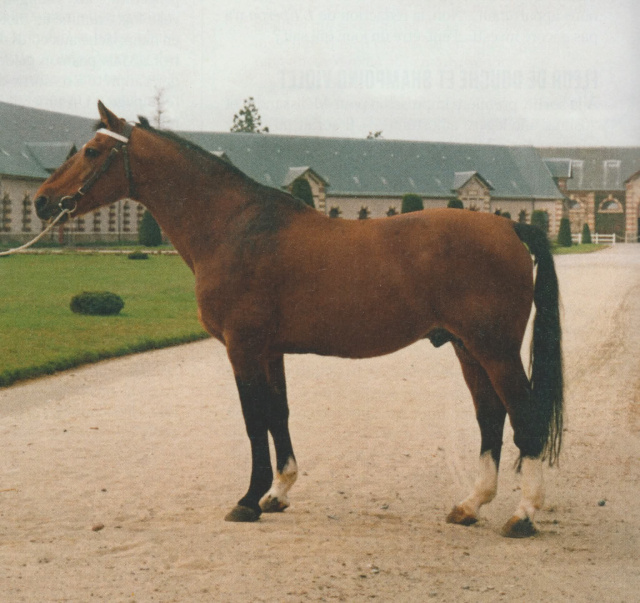
Ibrahim was born in Normandy in 1952 at the stud of René Haize. He was by The Last Orange, a son of the Thoroughbred Orange Peel xx, and out of Vaillante by Porte Bonheur.
The young stallion was reportedly purchased by horse dealer Alfred Lefevre for only 500 francs at a local fair. Nothing about that modest transaction suggested that one of the most influential jumping dynasties in history had just changed hands.
In 1956 he became champion of his age group and entered the French National Stud system, standing as a public stallion near Saint-Lô. Even then, recognition did not arrive quickly.
03 · The Stallion Who Waited
Ibrahim's early breeding career began quietly. Normandy breeders did not immediately see him as the future of the sport horse, and many of his first coverings were to heavier local mares rather than elite jumping families.
His first offspring were therefore given little of the attention that later generations would receive. Some were sold abroad before French breeders understood what they had.
Ibrahim himself had not been proven in high-level sport. His case would have to be made by the horses he produced — and that evidence took years to mature.
“Ibrahim did not become greater in 1970. The world simply became capable of seeing what had been standing in front of it all along.”
04 · The Evidence Arrives
Norvale, from Ibrahim's first crop, later competed internationally and became one of the early signs that his offspring possessed genuine sporting quality.
More successful descendants appeared, including horses such as Petit Prince C, Quo Vadis and Tango C. The pattern was no longer coincidence.
Demand rose dramatically, and Ibrahim reportedly covered a record fifty-four mares in one season — an extraordinary reversal for a stallion once largely overlooked.
At Fontainebleau, Ibrahim's offspring dominated the young-horse jumping finals. The breeding world could no longer ignore him.
05 · Fontainebleau
The defining public moment came at Fontainebleau in 1970. Ibrahim's young horses filled the leading places, with names including Alcazar D, Aurore C, Azimut, Arteban and Almé standing out in the finals.
It was the sort of domination breeders remember for decades. One successful horse can be chance. Several can be a good crop. A ring repeatedly filled with offspring of the same stallion is evidence of a sire.
By then Ibrahim was no longer the inexpensive horse bought at a fair. He had become a breeding force — although much of his greatest fame would arrive only after his death in 1973.
06 · Then Came Almé
Every great dynasty has a defining heir. For Ibrahim, that horse was Almé.
This is the reason Ibrahim is not simply a historical name on this website. His line can be followed without a missing step from 1952 to Noah and the latest horses bred at Warmblood Horse Sales.
07 · More Than One Great Son
The most famous son, and one of the greatest foundation stallions in modern jumping breeding.
An important French sire who carried Ibrahim's influence into further generations.
Sire of Fair Play III and part of another major route into international sport-horse pedigrees.
A recognised son within the broad Ibrahim dynasty.
Another approved and influential representative of the Ibrahim line.
Part of the extraordinary group through which Ibrahim's blood spread beyond France.
08 · The Ultimate Cross
One of Ibrahim's most important crosses came with daughters of Ultimate xx. That combination produced outstanding results, most famously Almé from Girondine by Ultimate.
It was a meeting of complementary qualities: Ibrahim's power, frame and jumping inheritance combined with the refinement, blood and athletic response brought through the Thoroughbred mare line.
The result was not merely a successful horse. It was a new branch of the sport's family tree.
09 · The Blood Behind Champions
Through Almé and his descendants, Ibrahim's influence appears behind many of the most celebrated jumping horses and sires of the modern era.
10 · The Living Connection
The Warmblood Horse Sales Hall of Fame exists to connect legendary horses to the animals living here now. Ibrahim's route is direct, documented and still active.
Ibrahim is therefore not included because he was once famous. He is included because his influence is still being born.
11 · The Breeder's Lesson
“Some stallions are celebrated because they won. Ibrahim became immortal because his offspring kept proving what breeders had failed to see in him.”
Ibrahim's story is one of the clearest arguments for patience in breeding. A young horse may be judged in a moment, but a stallion's real value can take years and several generations to reveal itself.
Bought cheaply, used cautiously and recognised late, Ibrahim became one of the foundations of a sport that now struggles to produce a major pedigree untouched by his influence.
The horse did not need history to make him great. History needed time to understand him.
12 · Continue the Bloodline Story
Historical details are compiled from French studbook, pedigree and published breeding records. Published databases differ on some totals and measurements; this page therefore concentrates on the well-established pedigree, timeline and living Warmblood Horse Sales connection.