
What the Race Record Said
Furioso xx made twenty-one starts without winning. On performance alone, there was no obvious reason to imagine that he would reshape European breeding.
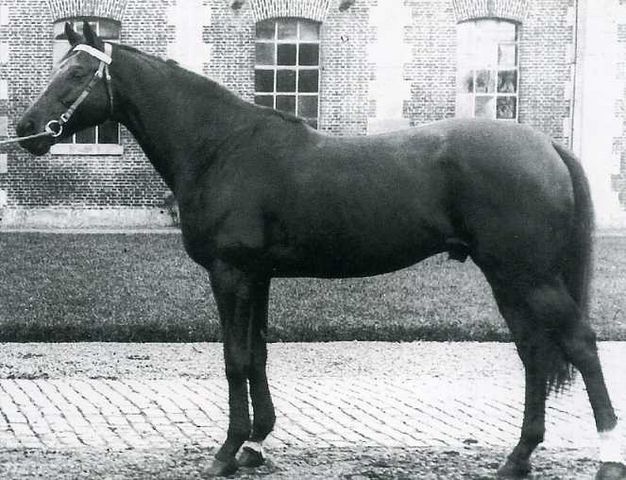
Warmblood Horse Sales · Hall of Fame
He never won a race. Yet this British Thoroughbred became one of the foundation stallions of modern European sport-horse breeding — and built two separate branches that meet again in horses bred at Warmblood Horse Sales.
01 · The Blood That Came Home
Furioso xx is not presented as a distant historical curiosity. He was a British Thoroughbred whose blood travelled into France, Germany, Belgium and the Netherlands, helped shape the modern warmblood, then returned to British soil through the pedigrees of Noah and the mares bred at Warmblood Horse Sales.
02 · The Thoroughbred
Furioso xx was foaled in Great Britain in 1939. He was by Precipitation xx out of Maureen xx by Son-in-Law xx.
His own racing record gave little warning of what would follow. He raced repeatedly without recording a victory. Judged only by race results, he might easily have disappeared into history.
After the Second World War, French breeders were searching for Thoroughbred blood capable of refining and modernising the French half-bred horse while preserving courage, bone and athletic usefulness. Furioso was selected for France and stood at the Haras du Pin.
The decision was visionary. France did not purchase a successful racehorse. It purchased the genetic possibility of a new kind of sport horse.
03 · The Great Contradiction
Furioso xx made twenty-one starts without winning. On performance alone, there was no obvious reason to imagine that he would reshape European breeding.
His progeny showed jumping ability, energy, courage and athletic quality. Once the first crops reached competition age, demand for him rose dramatically.
“Furioso xx is one of breeding's clearest reminders that the value of a stallion is not always visible in the discipline for which he was first bred.”
04 · France Recognised the Answer
Furioso's early breeding seasons were not an uninterrupted triumph. Breeders waited to see whether his foals would justify the experiment. When the first generations matured, the answer became impossible to ignore.
From the mid-1950s onward, demand for his services became intense. His descendants were proving that Thoroughbred refinement did not have to mean fragility, and that blood could add speed, courage and athletic response to the developing French sport horse.
His importance became so great that his memory remains associated with the Haras du Pin, the place where an unsuccessful British racehorse became a French breeding monument.
05 · The Horses Who Proved Him
Olympic individual showjumping gold medallist at Tokyo in 1964.
International and Olympic showjumping representative of Furioso's direct sporting influence.
The mare who became the dam of Jalisco B, extending Furioso into another world-famous sire family.
The dam of Fair Play III, carrying Furioso's influence into the Almé and international jumping story.
Full brother of Furioso II and sire of Le Mexico, central to Dutch and European jumping breeding.
The son who transformed German breeding and became the sire of Voltaire, For Pleasure and many more.
06 · The Two Brothers
One of the most breathtaking parts of Furioso's legacy is that two full brothers, Furioso II and Mexico, created separate breeding routes that later reappear together in the Warmblood Horse Sales family.
Their sire Noah carries Furioso xx through Mexico and Le Mexico. Their dam Davina carries Furioso xx through Furioso II and Voltaire. The same Thoroughbred foundation returns through two independent routes.
07 · Beyond Two Sons
Furioso xx did not create a legacy through a single fashionable son. He appears through male lines, through mares and through descendants that became foundations in their own right.
His daughter Tanagra produced Jalisco B. His daughter Ma Pomme produced Fair Play III. His granddaughter Quenotte produced Cor de la Bryère. Through such horses, Furioso's influence moved into several of Europe's most important studbooks and became woven into international showjumping rather than confined to one family.
That breadth is the difference between a successful sire and a breed-making stallion. Furioso did not simply produce winners. He produced the horses from which later dynasties were built.
08 · The Living Connection
This is the purpose of the Warmblood Horse Sales Hall of Fame. Furioso xx is not here because Brian wishes to be seen as a historian. He is here because a breeder should be able to show exactly where the qualities behind each foal came from.
Through Noah, Furioso reaches Rameros, Ramedoc, Zara and Ramesses II. Through Davina, he reaches Elizabeth Diamond and Maggie May. Where those families continue, his contribution continues with them.
09 · The Journey Home
Furioso xx was born in Great Britain in 1939. His racing record never made him a national hero, yet his blood became one of Britain's greatest contributions to European sport-horse breeding.
France recognised his breeding value. Germany expanded it through Furioso II. The Netherlands carried it through Voltaire and Le Mexico. Belgium combined those foundations with its own proven jumping families.
Across generations, the blood travelled through stallions, daughters and broodmares, crossing studbook borders while the modern warmblood was being built.
“Born a British Thoroughbred. Revered as a French foundation sire. His blood travelled across Europe before returning home through the horses of Warmblood Horse Sales.”
Today, Noah and the foals bred from him carry that history on AES passports bearing the Union Jack. The bloodline did not merely survive. It completed a journey.
It came home.
10 · The Breeder's Lesson
“Furioso xx failed in the job he was originally bred to do, then became indispensable to a sport for which nobody had tested him. His true ability was waiting in the next generation.”
That lesson belongs in breeding. Results matter, but they are not the whole horse. Pedigree, type, mind, athletic response and the qualities a stallion transmits may reveal something that his own career never had the opportunity to show.
Furioso xx became spectacular not because history chose to flatter him, but because generations of sport horses kept proving that the original French decision was right.
11 · Continue the Bloodline Story
Pedigree and historical details are compiled from published studbook and sport-horse breeding records. Sources differ on whether Furioso died in 1967 or 1968, so this page does not state an exact death year. The living Warmblood Horse Sales connection is traced through the documented Furioso II–Voltaire and Mexico–Le Mexico branches.